EMEGS (Qt version) is a standalone desktop application written in C++ and Qt. Unlike the original MATLAB edition, it does not require the MATLAB environment. Its unified interface and accelerated graphics support efficient interactive analysis and visualization.
Maintained binary releases are available for 64-bit Windows and Linux x86-64. The source is generally compatible with macOS and was built on macOS through EMEGS 2.0, but macOS is not actively supported and no maintained macOS binary package is currently provided.
Supported raw-data formats include BioSemi BDF, Electrical Geodesics/EGI RAW, Vitaport/Varioport VPD, and Biopac ACQ. Results can be stored in SQL databases, supporting flexible postprocessing, backup, and exchange with other analysis software.
Although its name reflects the project’s EEG/MEG origins, EMEGS (Qt version) also provides modules for ECG, electrodermal activity, reflexive startle, and heart-rate variability analysis.
Browse the source code and technical documentation on GitLab, or visit the download page for current binary packages.
ERP/ERF analysis

The ERP/ERF workflow includes filtering, epoch extraction, statistical artifact control (SCADS), artifact review, and event-related averaging. An ICA-based ocular-correction workflow is under active development.
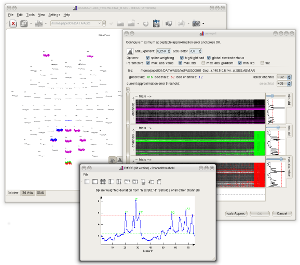

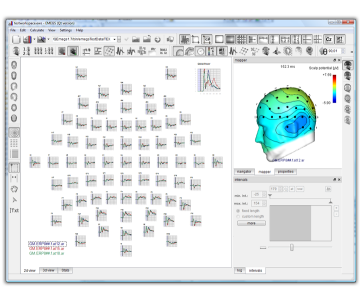
Two- and three-dimensional ERP/ERF visualization and statistical tools, including region-of-interest ANOVA, are integrated into the application. The ERP file format is shared with EMEGS for MATLAB, allowing both editions to be used with the same dataset.
ECG analysis

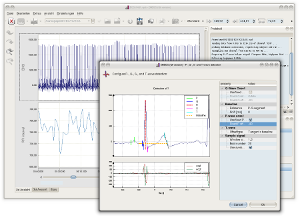
The ECG workflow supports Lead II electrocardiograms, detailed manual R-wave editing, PQRST identification, and export of derived parameters such as RR, QT, and PQ intervals and T-wave amplitude.
Reflexive startle analysis

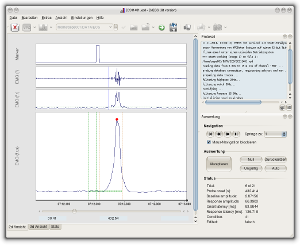
The reflexive startle EMG workflow provides filtering, rectification, smoothing, manual trial scoring, drag-and-drop baseline-window adjustment, onset- and response-latency editing, and optional within-subject normalization.
Electrodermal activity

The EDA workflow includes manual artifact editing, filtering and smoothing, and signal decomposition by deconvolution into tonic and phasic components.
Heart-rate variability

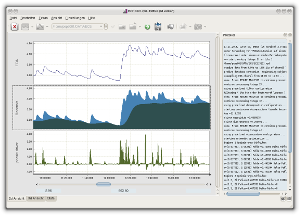
The HRV workflow calculates lnVLF, lnLF, and lnHF from the power spectral density of RR-interval series and provides tools for reviewing data quality.
License
EMEGS-owned code is free software licensed under the GNU General Public License, version 3 or (at your option) any later version. Bundled third-party components retain their respective licenses and attribution notices. See the license and attribution files in the public repository.